
By Topic
…
…

The battles on the Eastern Front constituted the largest military confrontation in history. They were characterized by unprecedented ferocity, wholesale destruction, mass deportations, and immense loss of life due to combat, starvation, exposure, disease, …

The decisive year was 1968. In the early morning of 30 January, Vietcong forces launched the Tet Offensive, named for the Vietnamese holiday then being observed. In coordinated attacks throughout South Vietnam, the Vietcong assaulted major urban areas a…

On May 07, 1954, Viet Minh forces won the Battle of Dien Bien Phu and ended French involvement in Indochina. This victory led to the Geneva Conference where the French and Viet Minh negotiated a ceasefire agreement. (Note: the other part of this photo c…

Erected in the dead of night on August 13, 1961, the Berlin Wall (known as Berliner Mauer in German) was a physical division between West Berlin and East Germany. Its purpose was to keep disaffected East Germans from fleeing to the West. When the Berlin…

"Politruk" (political commissar) Alexey Yeremenko (220th Rifle Regiment/4th Rifle Division) encouraging his men to counterattack against German positions moments before being killed, in the village of Khorosheye, near Woroschilowgrad, today Luhansk, Ukrain…

These photos taken by Johannes Hähle depict the civilian population of Kharkov under occupation by Nazi Germany (all pictures are taken in October and November 1941). As a member of Construction Battalion 146, Hähle participated in the invasion of Franc…

World War II planes bomb a hillside while a shellshocked reindeer looks on. The stark interface between the killing machines of man and the natural grandeur and beauty of the reindeer was not “natural”. Yevgeny Khaldei, the famous Soviet photographer wh…
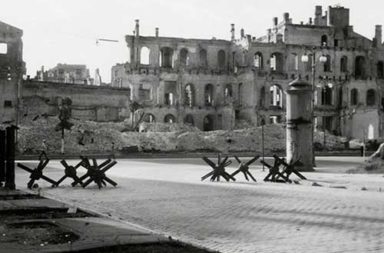
Herbert List was a German photographer, who worked for magazines, including Vogue, Harper's Bazaar, and Life, and was associated with Magnum Photos. He traveled regularly between Greece, Italy, and Paris until the outbreak of World War II, when he settl…

Shortly after Fidel Castro took power in Cuba in 1959, he visited the United States for two weeks, invited by the American Society of Newspaper Editors. The trip had all the features of a diplomatic tour— he met American officials, appeared on Meet the …

Chased by youth armed with clubs, this woman is fleeing from a "death dealer" whose left leg can be seen at the left-hand edge of the photograph. The Lviv pogroms were the consecutive massacres of Jews living in the city of Lwów (now Lviv, Ukraine), per…
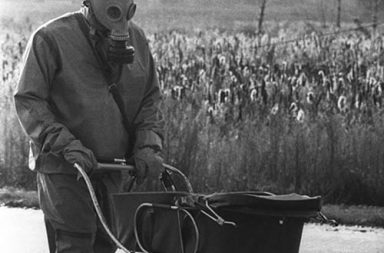
A liquidator, clad in a gas mask and protective clothing, pushes a baby in a carriage who was found during the cleanup of the Chernobyl nuclear accident. The infant had been left in an abandoned house in the village of Tatsenki. The worker found the chi…

The distance between the two of them is too close. The worker has his hands not hanging loose but slightly raised as though preparing to make a move. Meanwhile, the supervisor has that one hand at the collar of her dress like she's trying to slightly sp…

On July 20, 1969, Neil Armstrong became the first man to ever walk on the moon, starting a new era on the space exploration. We’re often subjected to the standard shots taken by Buzz Aldrin of the grey, rocky surface with a few faceless spacemen st…

Rudolf Hoess (Rudolf Höss) was the architect and commandant of the largest killing center ever created, the death camp Auschwitz, whose name has come to symbolize humanity's ultimate descent into evil. On 1 May 1940, Hoess was appointed commandant of a …

Mankind's road to the stars had its unsung heroes. One of them was the Soviet cosmonaut Vladimir Komarov. His spaceflight on Soyuz 1 made him the first Soviet cosmonaut to fly into outer space more than once, and he became the first human to die on a sp…

Here Fidel Castro is seen smoking a Cuban cigar and wearing two Rolex watches in the Kremlin while he chats with Khrushchev, in front of a Karl Marx picture. The non-verbal body language in this photo is absolutely fascinating. Notice everybody in the r…

Berlin after the War was a post-apocalyptic world. One of the largest and most modern cities in Europe was left a wasteland. There were vast piles of rubble everywhere. Other areas were rows of building walls with collapsed interiors — the skeletons of …

The embassy is an official state function and since the Third Reich outlived Hitler by six weeks, it would be odder if they did not raise the flag when the head of state died. Actually, Hitler's death wasn't officially announced until May 1st, but the O…

A somewhat odd photo and not terribly exciting unless you are aware of the details. Harold Agnew’s smile sort of disconnects the viewer from the reality of the situation. That box is the direct cause of the deaths of approximately 70,000 people. That li…