By Topic
…
…
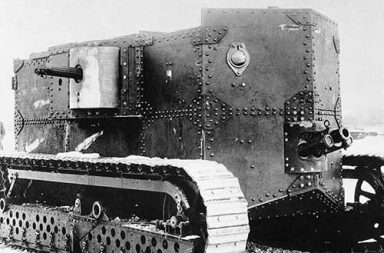
World War I was one of the defining events of the 20th century. From 1914 to 1918 conflict raged in much of the world and involved most of Europe, the United States, and much of the Middle East. In terms of technological history, World War I is signific…
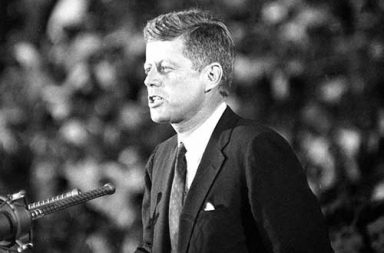
John F. Kennedy was born into a rich, politically connected Boston family of Irish-Catholics. He and his eight siblings enjoyed a privileged childhood of elite private schools, sailboats, servants, and summer homes. During his childhood and youth, "Jack…
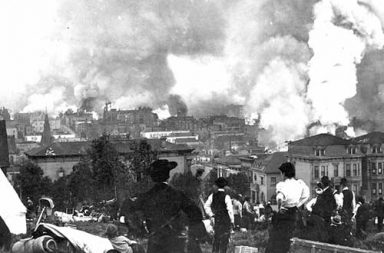
In the spring of 1906 San Francisco was a city boasting 410,000 inhabitants — a world-class metropolis whose citizens, at the dawn of a new century, looked forward with a sense of civic pride and growing confidence. San Francisco’s very existence was th…
On March 3, 1913, over 5,000 women marched down Pennsylvania Avenue in Washington, D.C. for universal women’s suffrage. The event was scheduled on the day before President Woodrow Wilson's inauguration to "march in a spirit of protest against the presen…
Isolation was a long American tradition. Since the days of George Washington, Americans struggled to remain protected by the mighty oceans on its border. When European conflicts erupted, as they frequently did, many in the United States claimed exceptio…
He was Korean – captured by the Japanese and pressed to fight the Soviets, captured by the Soviets and pressed to fight the Germans, captured by the Germans and pressed to defend Normandy, where he was captured by the Americans. This is the story of Yang K…
The decisive year was 1968. In the early morning of 30 January, Vietcong forces launched the Tet Offensive, named for the Vietnamese holiday then being observed. In coordinated attacks throughout South Vietnam, the Vietcong assaulted major urban areas a…
On May 07, 1954, Viet Minh forces won the Battle of Dien Bien Phu and ended French involvement in Indochina. This victory led to the Geneva Conference where the French and Viet Minh negotiated a ceasefire agreement. (Note: the other part of this photo c…
Erected in the dead of night on August 13, 1961, the Berlin Wall (known as Berliner Mauer in German) was a physical division between West Berlin and East Germany. Its purpose was to keep disaffected East Germans from fleeing to the West. When the Berlin…
New York Central's breathtaking Grand Central Terminal (or GCT) is a New York City landmark and world-famous station. It was built during the Golden Age of rail travel and exemplified the power and scope railroads wielded at that time. While the termina…
Until the atomic bomb could be tested, doubt would remain about its effectiveness. The world had never seen a nuclear explosion before, and estimates varied widely on how much energy would be released. Some scientists at Los Alamos continued privately to h…
The Second World War changed the United States for women, and women in turn transformed their nation. Over three hundred fifty thousand women volunteered for military service, while twenty times as many stepped into civilian jobs, including positions pr…
After Pearl Harbor, the Japanese quickly gained control over a huge area of the Pacific, from the Philippines to Burma to the Aleutians to the Solomons. While the Japanese enjoyed the advantage of interior lines of communication, they had somewhat overe…
For most of Finland's history, the country had lived on the periphery of world events, but for a few weeks during the winter of 1939-40, Finland stood at the center of the world stage. Finland's stand against Soviet aggression aroused the world's admira…
In the years leading up to the First World War Britain and Germany engaged in a naval arms race. Britain had peaceably enjoyed its status as the world’s dominant naval force since the Napoleonic Wars but Germany now sought to contest that dominance. A n…
Covering 1,216 acres, in Flushing Meadows, New York, the 1939 New York World's Fair, like the legendary Phoenix rising from the ashes, was erected on what was an ash-dump. The theme, "Building the World of Tomorrow" echoed in virtually every corner of the …
Rescued East African slaves taken from a dhow aboard HMS Daphne, a British naval ship used to prevent the transportation of enslaved people. They were freed from Arab slave traders between November 1st and 4th of 1868. The HMS Daphne was sailing along t…
The Japanese surprise attack on Pearl Harbor began just before 8 a.m. local time Sunday morning, December 7, 1941. For over an hour, in two waves, some 350 Japanese aircraft—having taken off from six aircraft carriers 230 miles north of Oahu—attacked th…
While the First World War witnessed the development of modern, technological warfare, it also made unprecedented demands on what we might see as archaic methods of campaigning. Despite the tanks, planes, and machine guns, fighting still depended on the …