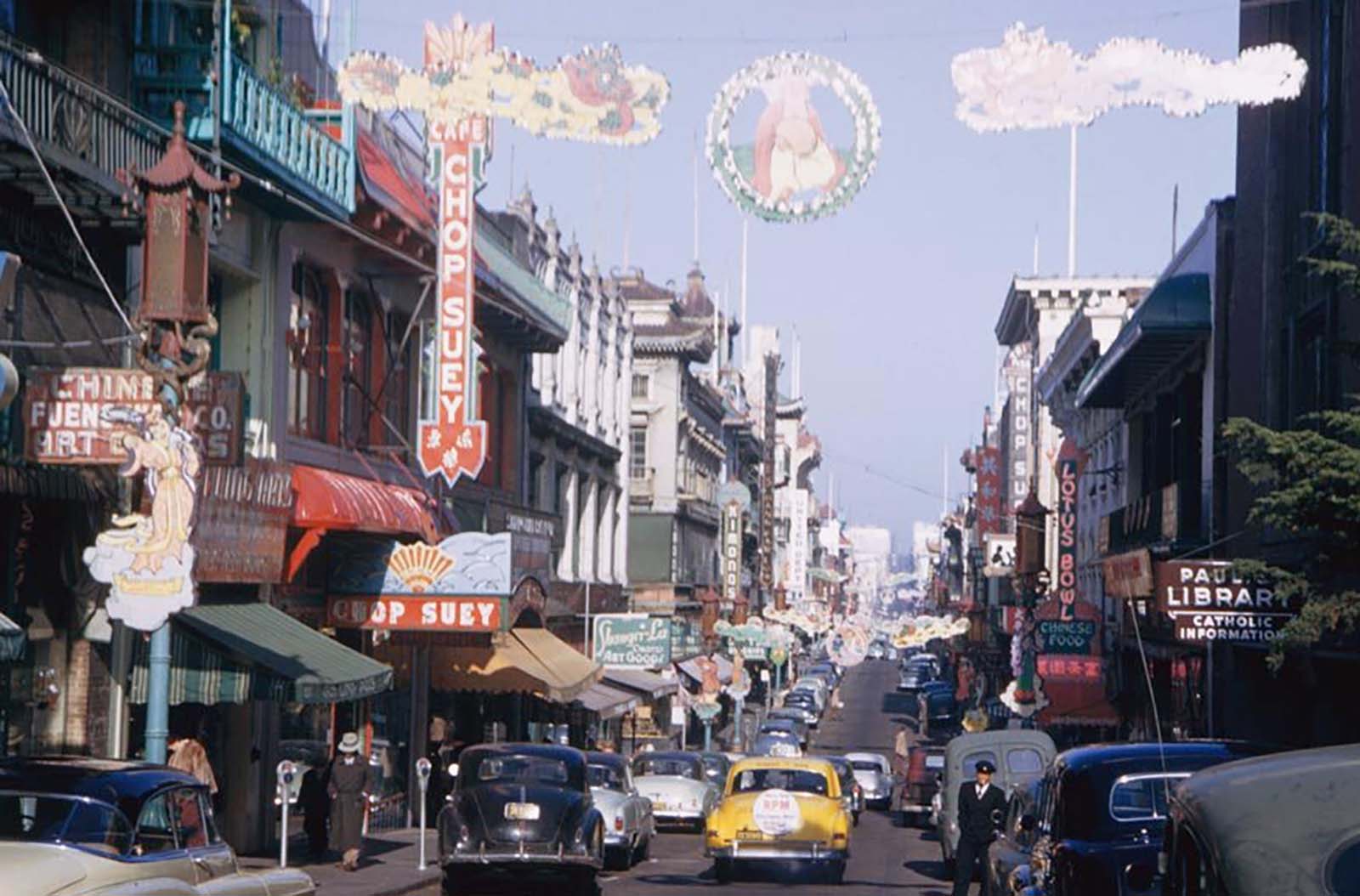
San Francisco in the 1940s was a city of striking contrasts, where historic neighborhoods, busy waterfronts, steep streets, and familiar cable cars stood against the backdrop of a world at war.
The decade brought enormous changes to the city, turning its harbor into a major gateway to the Pacific and bringing thousands of servicemen, sailors, and workers through its streets.
Military activity filled the waterfront, shipyards operated around the clock, and local businesses adapted to wartime demands.
 Yet much of the city’s familiar character remained, from the colorful houses of its residential neighborhoods to the bustling shops and restaurants downtown.
Photographs by Charles W. Cushman offer a fascinating record of this period, capturing San Francisco’s architecture, landmarks, waterfront, and people during a decade that shaped its modern identity.
 When the United States entered World War II following the attack on Pearl Harbor in December 1941, San Francisco quickly became one of the country’s most important military centers.
Its location on the Pacific coast made it a natural departure point for troops and supplies heading to the war in Asia and the Pacific islands.
Fort Mason served as a major port of embarkation, while the Presidio and other military installations played important roles in organizing and supporting the war effort.
 Soldiers in uniform became a familiar sight around the city, particularly near transportation hubs, hotels, restaurants, and the waterfront. For many servicemen, San Francisco was their last major stop before shipping overseas.
The war also transformed the region’s economy. Shipyards throughout the San Francisco Bay Area expanded rapidly, including facilities at Hunters Point, Richmond, Oakland, and Sausalito.
Thousands of workers arrived in search of employment, and factories, warehouses, and transportation services operated at an intense pace.

During the war, the San Francisco Port of Embarkation handled more than 1.6 million military personnel and over 23.5 million ship tons of supplies and equipment.
The influx of workers and military personnel brought new energy to the city, but it also placed considerable pressure on housing, public transportation, and other services.
Women entered industrial jobs in growing numbers, taking on work that had previously been dominated by men.

Wartime San Francisco was not without its darker chapters. Following the government’s forced removal and incarceration of Japanese Americans in 1942, the city’s Japanese American community was profoundly disrupted.
Families lost homes, businesses, and livelihoods, while entire neighborhoods experienced the consequences of their absence.
These events remain an important part of the city’s history and provide a reminder that the wartime changes were not equally experienced by everyone.

Away from the military installations and industrial waterfront, everyday life continued.
Cable cars carried passengers up and down the city’s famous hills, streetcars connected residential neighborhoods with downtown, and Market Street remained one of the busiest commercial corridors.

Fisherman’s Wharf attracted visitors with its seafood restaurants and fishing boats, while Chinatown maintained its distinctive shops, markets, and restaurants.
The city’s Victorian houses, apartment buildings, theaters, and neighborhood storefronts gave San Francisco a character quite different from the rapidly expanding cities of the American West.

The end of World War II in 1945 brought celebrations and a new sense of optimism. Servicemen returned home, wartime restrictions gradually eased, and businesses shifted their attention from military production to civilian needs.
San Francisco also gained international prominence that year when it hosted the United Nations Conference on International Organization, where representatives from 50 countries gathered to establish the United Nations Charter.
The event placed the city at the center of an important moment in postwar history.
 The economy continued to benefit from the region’s strong shipping, trade, manufacturing, and financial sectors.
The waterfront remained busy, although the shipping industry would gradually change as new technologies and larger cargo facilities reshaped maritime trade.
Tourism also became increasingly important, with visitors drawn to the Golden Gate Bridge, Chinatown, Fisherman’s Wharf, cable cars, and the city’s distinctive neighborhoods.
Restaurants, hotels, department stores, and entertainment venues benefited from renewed prosperity as Americans had more opportunities to travel and spend money.
 By the end of the decade, San Francisco was entering a new chapter.
The wartime population boom had left a lasting mark, and the returning servicemen, growing economy, and expanding suburbs were changing the region.
Nevertheless, the city retained much of its architectural charm and recognizable character. Its waterfront, historic buildings, steep streets, and busy commercial districts continued to define the landscape.
 These vintage photographs offer more than a collection of attractive old city scenes.
They preserve a record of San Francisco during a period of profound change, from the wartime activity around its harbor to the familiar routines of neighborhood life and the optimism of the postwar years.


Photos Capture Daily Life in San Francisco, 1943
Here’s a collection of interesting black and white photographs of daily life in San Francisco during wartime. All photographs were taken by LIFE photographer Meith Hagel in 1943.


(Photo credit: : Charles W. Cushman Photograph Collection / Indiana University Archives / Library of Congress / Meith Hagel, via LIFE archives).