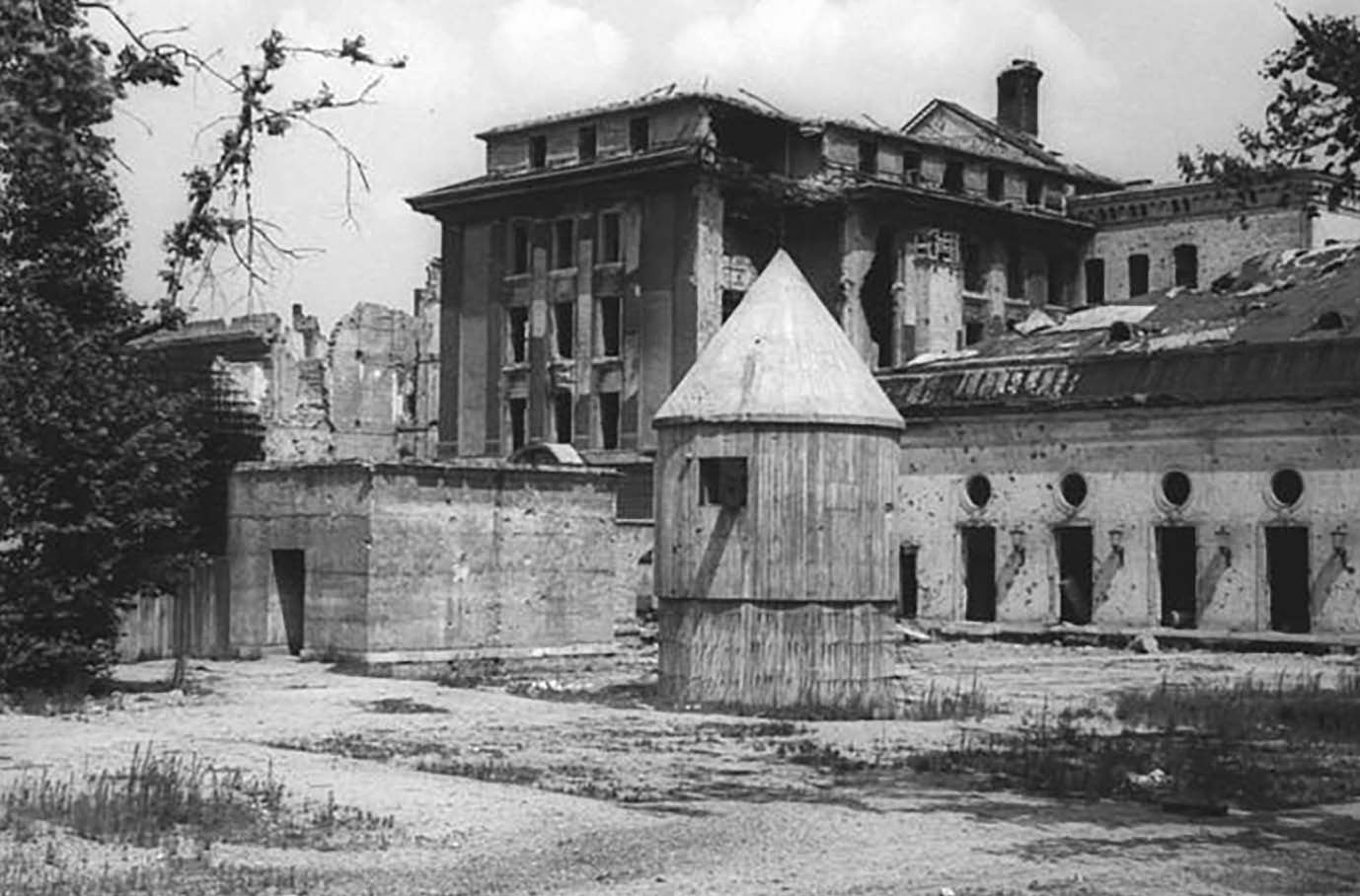
 In the final days of April 1945, as Soviet troops fought their way into central Berlin, Adolf Hitler remained underground in the Führerbunker, a reinforced concrete shelter beneath the garden of the Reich Chancellery.
The German capital was collapsing around him, the Nazi leadership was in disarray, and the war in Europe was nearing its end. On April 30, Hitler and Eva Braun died by suicide inside the bunker.
Just days later, American photographer William Vandivert entered the captured complex and documented its rooms, abandoned belongings, and the wreckage of the Chancellery above.
His photographs, taken in the immediate aftermath of Berlin’s fall, preserve a remarkable record of the place where the Third Reich came to its end.

Oberwallstrasse, in central Berlin, saw some of the most vicious fighting between German and Soviet troops in the spring of 1945.
William Vandivert was a photojournalist who worked for LIFE magazine from the late 1930s through 1948. In the spring of 1945, he traveled to Germany to document the aftermath of the fighting.
Berlin had suffered months of Allied bombing before Soviet forces launched their final offensive against the city on April 16.
After two weeks of brutal street fighting, German resistance collapsed, and the Soviet Union took control of the capital on May 2.

Hitler’s bunker partially burned by retreating German troops and stripped of valuables by invading Russians.
Vandivert arrived shortly afterward and gained access to the remains of the Reich Chancellery and the underground bunker.
He became the first Western photographer to document the bunker’s interior after the fall of Berlin. A selection of his photographs appeared in LIFE in July 1945, while many others remained unpublished for decades.
The Führerbunker was part of a larger underground complex beneath the Reich Chancellery, the seat of Hitler’s government in Berlin. Its construction took place in stages.

A 16th century painting reportedly stolen from a Milan museum.
An earlier air-raid shelter, known as the Vorbunker, was built in 1935 and 1936 beneath a reception building at the Old Reich Chancellery.
As Allied bombing intensified, a deeper and more heavily protected structure was commissioned in 1943.
Construction began that year, and the main Führerbunker was officially completed in October 1944. The two shelters were connected by an underground passage, allowing occupants to move between them.

With only candles to light their way, war correspondents examine a couch stained with blood (see dark patch on the arm of the sofa) located inside Hitler’s bunker.
The main bunker was an extensive reinforced-concrete structure, with its floor approximately nine meters below ground.
Its exterior measured roughly 27 meters long and 22 meters wide, while its ceiling and outer walls were approximately 3.5 meters thick.
The complex contained offices, private living quarters, bedrooms, bathrooms, a kitchen, a medical room, and conference facilities.

Abandoned furniture and debris inside Adolf Hitler’s bunker, Berlin, 1945.
Hitler’s private quarters included a bedroom and sitting room, while Eva Braun had separate accommodation nearby.
There were also rooms for military personnel, security staff, and other members of the Nazi leadership.
Although heavily fortified against aerial attacks, the bunker was a confined underground environment with no natural daylight, relying on artificial lighting and ventilation.

Papers (mostly news reports dated April 29, the day before Hitler and Eva Bruan killed themselves) inside Hitler’s bunker, Berlin, 1945.
Hitler moved into the Führerbunker on January 16, 1945, as the military situation deteriorated rapidly.
From there, he continued receiving reports from the front and issuing orders to German commanders, even as Soviet forces advanced toward the capital.
By April, the Red Army had reached the outskirts of Berlin and launched its final offensive on April 16.
Soviet troops encircled the city on April 25 and pushed toward the government district, where German soldiers, members of the Volkssturm, and Hitler Youth units attempted to resist the advancing forces.
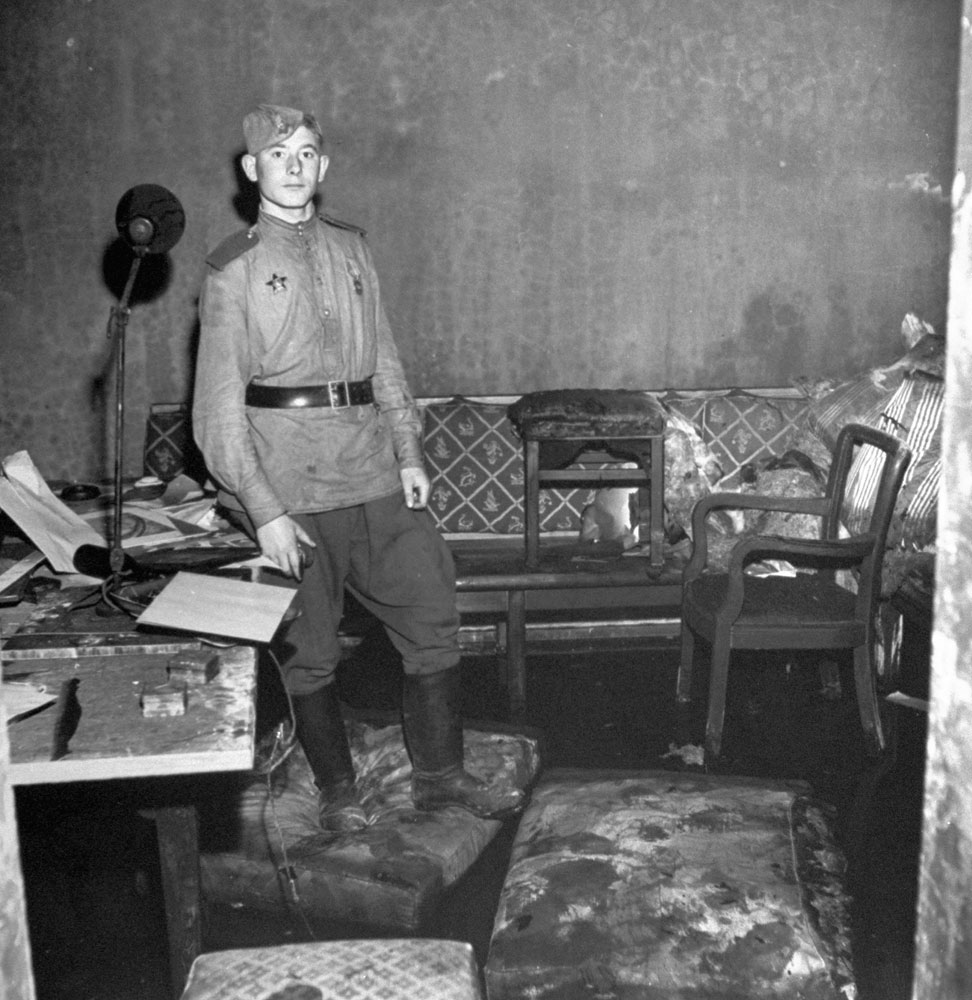
A Russian soldier stands in Adolf Hitler’s bunker, Berlin, 1945.
Fighting continued through the streets, often from building to building, while civilians struggled to find shelter amid the bombardment.
On April 29, Hitler married Eva Braun in a small ceremony inside the bunker. The following afternoon, April 30, both died by suicide in Hitler’s private quarters.
Hitler shot himself, while Braun took cyanide. Their bodies were carried into the garden of the Reich Chancellery and burned by members of Hitler’s staff.

Desk inside Adolf Hitler’s bunker, Berlin, 1945.
Soviet troops were already fighting close to the complex, and the collapse of the Nazi leadership was only days away.
Berlin’s remaining German forces surrendered on May 2, bringing the battle for the capital to an end. Germany’s unconditional surrender followed on May 7 and 8, 1945, marking the end of the war in Europe.

An SS officer’s cap, with the infamous death’s-head skull emblem barely visible.
When Vandivert entered the complex, the rooms offered a revealing picture of the final hours of the Nazi leadership.
Furniture, personal belongings, scattered papers, and other objects remained among the damaged interiors. Soviet soldiers had already searched parts of the structure, and the rooms showed signs of destruction and disorder.
Vandivert documented the private quarters, the conference areas, and the surroundings of the Chancellery.

A ruined, empty and likely looted safe inside Hitler’s bunker.
In his notes to LIFE editors in New York, he also described the conditions under which he photographed the interior, including the use of a candle to illuminate some of the dark rooms.
The destruction above ground was equally extensive. The New Reich Chancellery, Hitler’s imposing government headquarters, had been heavily damaged during the fighting and was later demolished.
Vandivert photographed its shattered interiors, damaged facades, and the remains of Nazi symbols that Soviet soldiers were removing from the buildings.

LIFE correspondent Percy Knauth, left, sifts through debris in the shallow trench in the garden of the Reich Chancellery where, Knauth was told, the bodies of Hitler and Eva Braun were burned after their suicides.
Residential streets and commercial districts across central Berlin were also filled with rubble.
Many buildings had lost their roofs and upper floors, while others had been reduced to little more than their exterior walls.
The photographs provide a record of the capital immediately after its capture, before postwar reconstruction began to reshape the city.

In the garden of the Reich Chancellery, Berlin, 1945.
The Führerbunker itself was partially demolished in 1947, when Soviet authorities attempted to destroy the underground structure.
Further demolition and clearance work followed in 1958 and 1959, with additional underground remains removed during redevelopment in the late 1980s.
The site was eventually filled in and covered, leaving little visible evidence of the complex that once stood beneath the Chancellery garden.
Today, the former location is near Gertrud-Kolmar-Straße in central Berlin. An information board marks the site and explains its history, while the surrounding area has been redeveloped with residential buildings and parking spaces.

Bullet-riddled sentry pillbox outside Hitler’s bunker, Berlin, 1945.

An unidentified hand on the destroyed hinge of the door to Hitler’s bunker, burned off by advancing Russian combat engineers, Berlin, 1945.

Empty gasoline cans, reportedly used by SS troops to burn the bodies of Hitler and Eva Braun after their suicides in the bunker, Berlin, 1945.

Russian soldiers and a civilian struggle to move a large bronze Nazi Party eagle that once loomed over a doorway of the Reich Chancellery, Berlin, 1945.

An American soldier, PFC Douglas Page, offers a mocking Nazi salute inside the bombed-out ruins of the Berliner Sportspalast, or Sport Palace. The venue, destroyed during an Allied bombing raid in January 1944, was where the Third Reich often held political rallies.

At the Reichstag, evidence of a practice common throughout the centuries: soldiers scrawling graffiti to honor fallen comrades, insult the vanquished or simply announce, I was here. I survived. Berlin, 1945.

An image almost too perfectly symbolic of Berlin in 1945: A crushed globe and a bust of Hitler amid rubble outside the ruined Reich Chancellery.
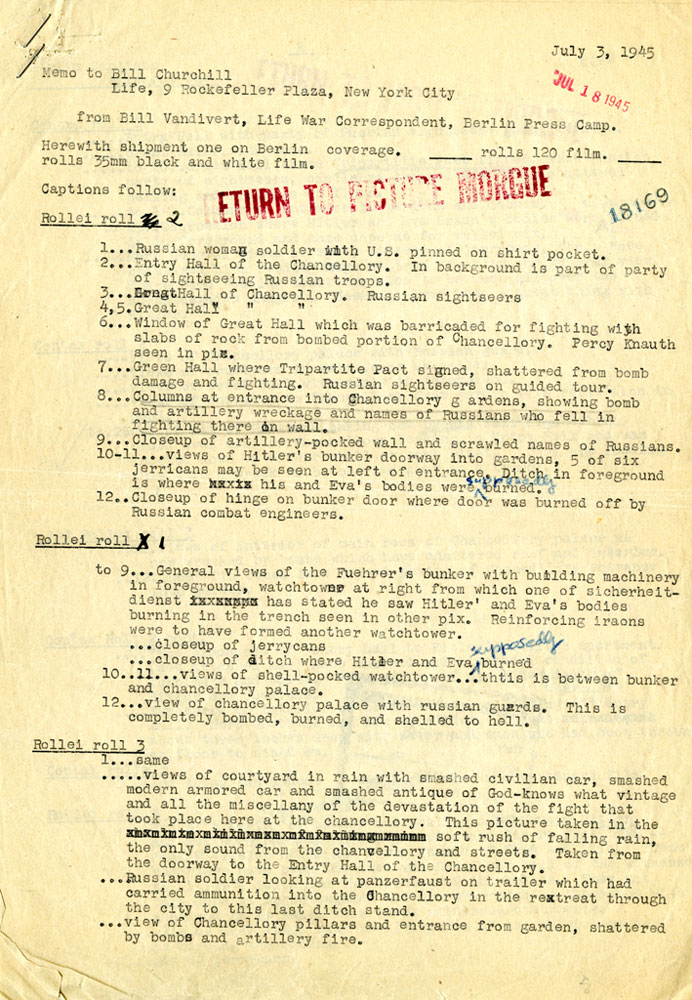
The first of the approximately 20 pages of notes that William Vandivert typed for LIFE’s editors in New York, describing not only the pictures he took but also the atmosphere pervading his examination of Hitler’s bunker and the Reich Chancellery grounds. (An example of Vandivert’s terse, vivid notations: “… view of chancellery palace … completely bombed, burned and shelled to hell.”)
(Photo credit: William Vandivert—Time / Life Pictures).