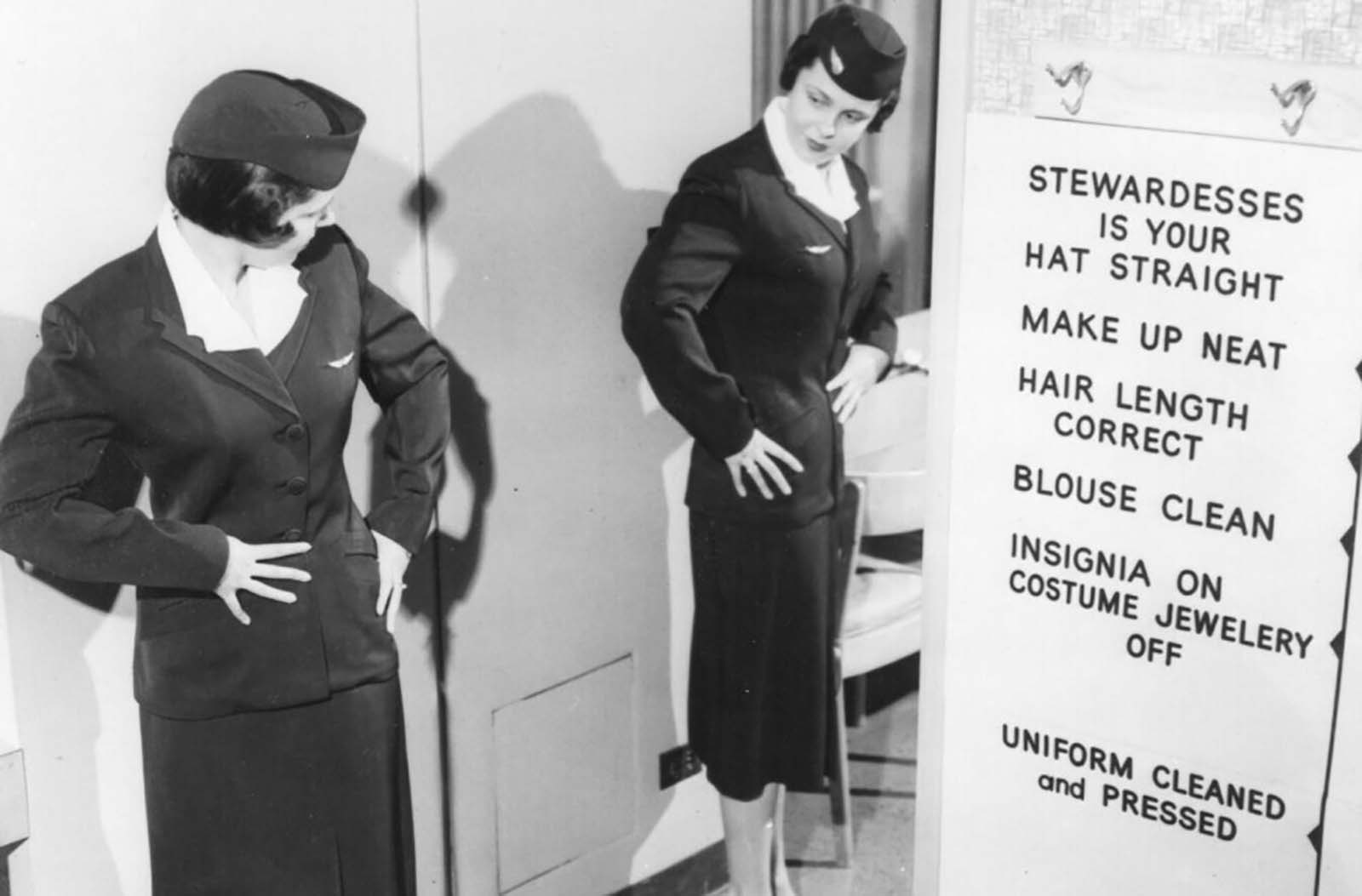
Before a woman could step onto a plane as a stewardess, she had to clear a set of requirements that bore no resemblance to anything related to aviation.
No safety certification, no navigation knowledge, no emergency training. The checklist that determined her eligibility was built entirely around her physical appearance, the sound of her voice, the scent she wore, and the details of her romantic life.
Airlines in the 1950s did not hire based on competence. They hired based on image, and they enforced that image with remarkable precision.

The ideal stewardess was young, unmarried, slender, and polished in a very specific way.
These expectations were not unspoken cultural pressures or vague managerial preferences. They were formal, written policies, applied consistently and without apology.
What follows is a look at exactly what those policies required, and a reminder of how completely a woman’s professional worth was once measured by standards that had nothing to do with her ability to do the job.
1. A Hairstyle That Signaled Femininity
 Hair was not a personal choice in the 1950s cabin crew. Stewardesses were required to wear their hair short, neat, and unmistakably feminine.
The goal was a polished, ladylike appearance that matched the image airlines worked hard to project: graceful women serving graceful passengers in a graceful era of travel.
2. Makeup That Enhanced Without Overpowering
 Stewardesses were expected to wear makeup on every flight, but the rules around it were precise. The look had to be natural and refined, enough to appear put-together, but never bold or theatrical.
The underlying standard, never fully written but clearly understood, was attractiveness that did not draw too much attention to itself.
3. Perfectly Manicured Hands
 Hands were considered part of the uniform. Airlines expected stewardesses to maintain soft, lightly manicured hands at all times, with a finish natural enough to look effortless.
As the most visible part of a flight attendant’s body during service, they were treated as a reflection of the airline’s overall standards.
4. Jewelry Kept to a Careful Minimum
 Accessories were permitted within strict limits. A single strand of pearls, one small charm, and a pair of stud earrings represented the outer boundary of acceptable jewelry.
Anything beyond that was considered excessive and out of keeping with the restrained, professional image airlines wanted their stewardesses to project.
5. A Weight Limit of 135 Pounds, Enforced Before Each Shift
 This is perhaps the most startling rule by today’s standards. Stewardesses were weighed before reporting for duty on every flight.
The maximum allowable weight was 135 pounds, and even a marginal excess meant being sent home without pay.
The policy was eventually abolished, though not before it defined the working conditions of an entire generation of women in aviation.
6. A Girdle Was Part of the Uniform
 Maintaining the required weight was not considered sufficient on its own.
Stewardesses were also required to wear a fitted girdle beneath their uniforms, ensuring their silhouette conformed to the airline’s exacting standards at all times. Appearance, in every sense, was treated as a professional obligation.
7. Height Between 5’2″ and 5’6″
 Height requirements were strictly defined. Women had to stand between 5 feet 2 inches and 5 feet 6 inches to qualify, a range that allowed for the high heels that were also part of the required uniform.
The combination was intended to create a consistent, visually uniform cabin crew. Today, height restrictions of this kind are illegal in most countries.
8. Skirt Hemlines Had to Fall Just Right
 Hem length was another area subject to formal guidelines. Skirts could not be too long or too short.
The acceptable hemline landed at a specific, modest point that airlines deemed appropriate for professional service, and supervisors were known to inspect it.
9. Smooth, Hair-Free Legs at All Times
 Stewardesses were required to have fully smooth legs, a standard that was checked and enforced.
Even minor stubble was considered unacceptable, and the expectation applied regardless of personal preference or circumstance.
It is a requirement that reads, in retrospect, as a striking example of how completely airlines felt entitled to regulate the physical appearance of their female employees.
10. Well-Groomed Feet
 Because stewardesses wore open-style heels that exposed portions of the foot, foot grooming was included in the list of formal requirements.
Clean, neat, and carefully maintained feet were considered part of the overall standard of appearance, a detail that illustrates just how thorough these regulations were.
11. A Soft, Measured Speaking Voice
 Stewardesses were trained to speak in a calm, well-modulated tone at all times. Raising one’s voice, under any circumstances, was grounds for correction.
Some airlines went further, offering specific instruction on vocal delivery as part of the onboarding process, treating tone and pitch as professional skills on par with service technique.
12. A Pleasant, Subtle Fragrance
 Wearing perfume was expected, but the amount and type were carefully controlled.
The fragrance had to be light enough to go unnoticed by most passengers while still contributing to the overall impression of freshness and elegance.
Too much, and it became a distraction. Too little, and it failed the standard. Airlines, apparently, had opinions about this too.
13. Single, Unattached, and Expected to Stay That Way
 Marriage disqualified a stewardess from her position. So, in many cases, did having a serious romantic partner.
Airlines operated under the belief that a stewardess’s full attention and personal identity should remain aligned with her professional role, unmarried and unencumbered. A woman who got married during her employment was typically required to resign immediately.
This policy, among the most contested of the era, was not fully dismantled in the United States until the 1970s, following sustained legal challenges from flight attendants who refused to accept it.
(Photo credit: Wikimedia Commons / Flickr).