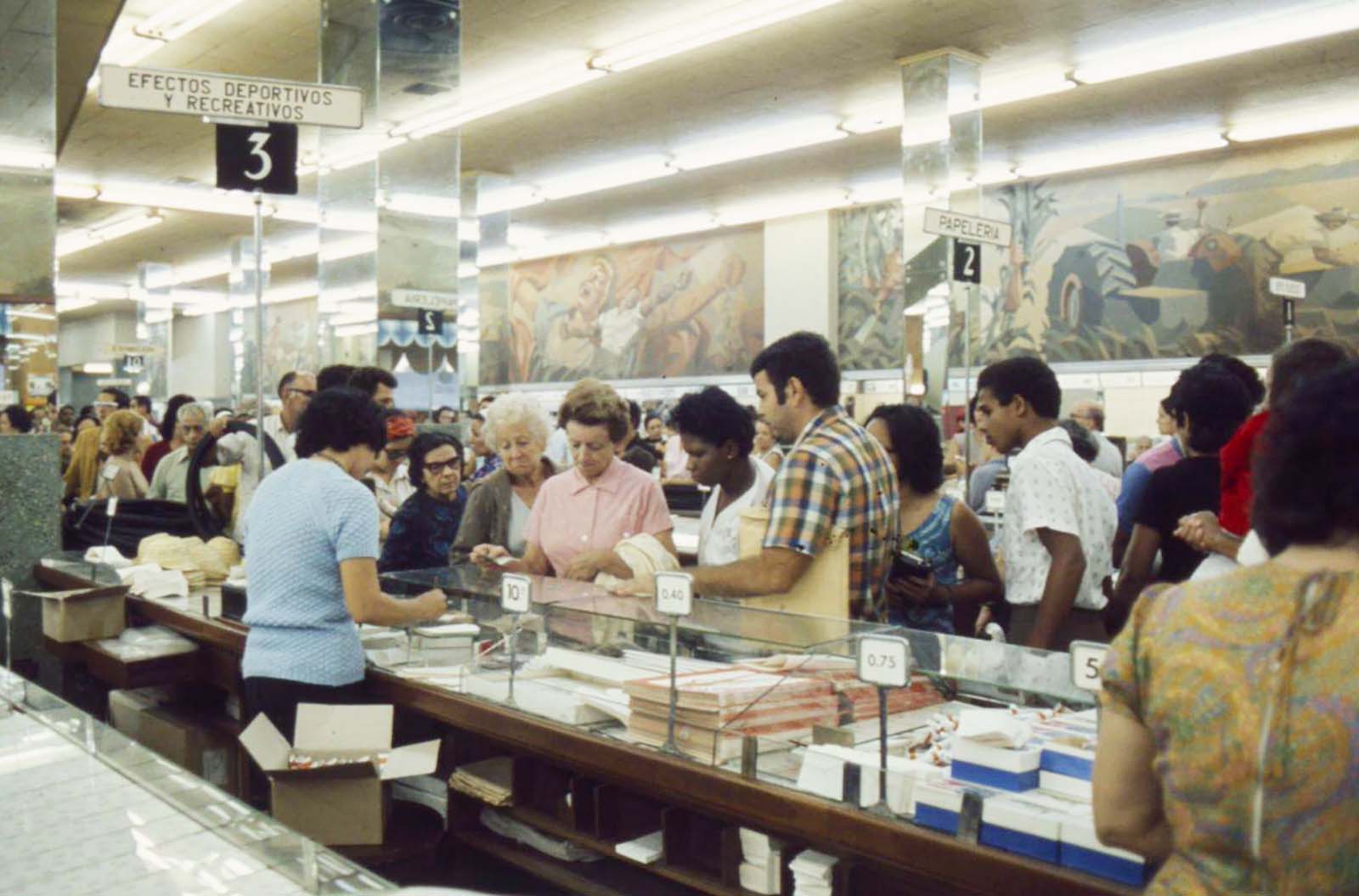
 A decade after Fidel Castro’s revolution reshaped the island, Cuba in the 1970s was a country still finding its footing, caught between the optimism of a new social order and the harsh realities of economic isolation.
Photographer Manel Armengol traveled through towns like Matanzas in 1976, capturing the unscripted rhythms of daily life: workers heading to their jobs, children playing in the streets, and families navigating a system unlike anything in the Western Hemisphere.

Cuba, Matanzas, 1976. An old colonial street of Santa Clara. A sign marks the headquarters of the Workers’ Social Circle
By the mid-1970s, Cuba had entered what historians often call its “institutionalization” period.
The improvised, revolutionary energy of the 1960s gave way to formal structures: a new constitution was drafted in 1976, the Communist Party held its first congress, and the government adopted Soviet-style five-year economic plans.
Cuba had also joined COMECON, the Soviet bloc’s economic alliance, in 1972, tying its fortunes closely to Moscow and securing subsidized oil and machinery in exchange for sugar exports.

Cuba, Matanzas, 1976. Colorful masks announcing the Carnival in a square in Matanzas
That dependence on sugar shaped much of everyday life. The crop remained Cuba’s economic backbone, and the government pushed ambitious harvest targets throughout the decade.
Agricultural labor, including seasonal sugarcane cutting, touched nearly every community, with volunteer brigades and state-organized labor campaigns a regular part of life for many Cubans.

Cuba, Matanzas, 1976. Political slogan ‘To decide and govern with the people’s power’ on top of a colonial building
For ordinary families, the most visible feature of the era was the rationing system. Introduced in 1962 and still firmly in place by the 1970s, the libreta, or ration booklet, governed access to food staples, clothing, and household goods.
Lines outside government-run shops were a common sight, and resourcefulness became a daily skill as families stretched limited supplies.
The United States trade embargo, tightened over the years, compounded these shortages and pushed Cuba further into reliance on Soviet trade.

Cuba, Matanzas, 1976. Pool and garden of a national tourism resort in Cuba
Despite the constraints, the government invested heavily in social programs. Education and healthcare were free and expanded rapidly during this period, with literacy campaigns from the previous decade giving way to broader access to schooling.
Housing construction, while often slow, aimed to address overcrowding in cities like Havana, where many colonial-era buildings showed visible signs of age and limited maintenance.
Classic American cars from the pre-revolutionary era, kept running through homemade repairs, became an unintended but enduring symbol of the period, a reflection of both ingenuity and isolation from global markets.
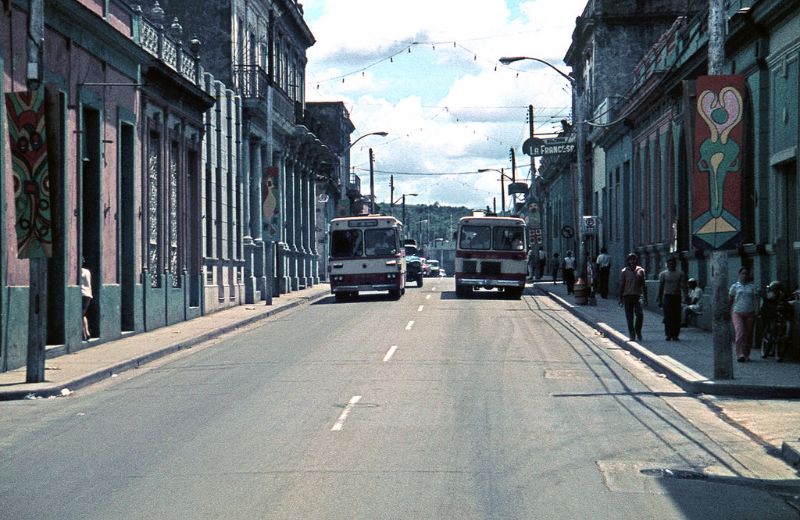
Cuba, Matanzas, 1976. Two buses at avenue with colonial buildings
Cuban society in the 1970s also saw shifts in social policy. The Family Code of 1975 formally recognized equal responsibilities between spouses in the home, part of a broader push to bring women into the workforce and public life.
Music, baseball, and community gatherings remained central to daily culture, offering moments of normalcy and celebration amid economic hardship.

Cuba, Santa Clara, 1976. Building of the Nueva Trova of Cuba
Beyond the cities, rural Cuba carried its own distinct character during this period. State farms and cooperatives reorganized much of the countryside, with the government promoting collective agriculture as a path toward self-sufficiency outside the sugar sector.
Coffee, tobacco, and citrus production received renewed attention, though results varied from region to region.
Transportation remained a persistent challenge nationwide, with fuel shortages and aging infrastructure making travel between provinces slow and often unpredictable.

Cuba, Santa Clara, 1976. Colonial building at Parque Vidal, esquina del Museo de Artes Decorativas
On the international stage, Cuba expanded its presence well beyond its borders during these years, sending troops and advisors to support allied movements in Angola and Ethiopia, part of a broader effort to position itself as a leader among nonaligned and socialist nations.
At home, this global engagement coexisted with the daily grind of rationing and scarcity, creating a country that projected confidence abroad while managing real limitations within its own borders.
That contrast, between ambition and constraint, came to define much of Cuba’s experience throughout the decade, setting the stage for the economic and political challenges that would follow in the years ahead.

Cuba, Santa Clara, 1976. Lattice of a house and boys talking in the neighborhood of the ancient Havana

Cuba, Santa Clara, 1976. Maceo street

Cuba, Santa Clara, 1976. Man unloading flour sacks from his truck

Cuba, Santa Clara, 1976. Santa Clara Libre Hotel

Cuba, Santa Clara, 1976. Havana’s Coppelia building (left) is one of the largest ice cream parlors in the world. Holding 1000 guests, it is located on the part of Calle 23 known as La Rampa in the Vedado district. There is also the headquarters of La Nueva Trova

Cuba, Trinidad, 1976. A man walking and old truck

Cuba, Trinidad, 1976. Three men on the street

Group of traditional musicians ‘Septeto Tradicional de Santa Clara’

Cuba, 1976. A group of happy mothers with a child

Cuba, 1976. A teacher taking care of children playing with their toys

Cuba, 1976. Area with a processing agricultural products plant and workers’ housing

Cuba, 1976. Boys playing in the waves on a beach

Cuba, 1976. Boys playing with a kite in an agricultural region with farmers’ houses and palm trees along the lake

Cuba, 1976. Children doing school work

Cuba, 1976. Children having fun in front of the camera

Cuba, 1976. Children in a kindergarten in front of TV

Cuba, 1976. Country road in the interior of the island. Warning over rail crossing, truck and people passing. A billboard recommends “More productivity and More development”

Cuba, 1976. Cuban families on holidays having fun at the beach

Cuba, 1976. Cuban families on holidays having fun at the beach

Cuba, 1976. Cuban farmer

Cuba, 1976. Cuban men waving good-bye

Cuba, 1976. Cubans on holiday at the beach. Santa María del Mar beach, near Guanabo and Havana

Cuba, 1976. Farmers home and two young girls in their garden

Cuba, 1976. Girls playing combing dolls during recess at a nursery

Cuba, 1976. Interior of a school with children doing school work

Cuba, 1976. Little girl at the entrance to her home

Cuba, 1976. Man sitting in his green wagon pulled by a horse, laughing and pointing a direction with his arm

Cuba, 1976. Man with a straw hat and a blue truck

Cuba, 1976. Members of ANAP (Asociación Nacional de Agricultores Pequeños) in a informative session with professors and journalists from Barcelona, Spain

Cuba, 1976. Oasis with palm trees in the interior of Cuba

Cuba, 1976. Old American cars parked on a street with old houses. In a sign at the street: “Emulation Meetings between CDR and Zoning Committee announced”

Cuba, 1976. On the road, an old American car, a horse and cart and a tractor. Sign near the road of socialist government message: “To decide and govern with the people’s power”

Cuba, 1976. People bathing in the sea and children running while the wind announces the arrival of a storm

Cuba, 1976. Red tractor in a Cuban farm

Cuba, 1976. Swinging in the playground of the nursery

Cuba, 1976. Three boys with a kite

Cuba, 1976. Two men unload a truck in the traditional way

Cuba, 1976. Women group with their child

Cuba, 1976. Zafrero (man who works in the Zafra harvesting sugarcane)

Cuba, Escambray Mountains, 1976. Public transport, bus line

Cuba, Habana Vieja, 1976. Headquarters building of Regional Committee Centro-Habana del C.D.R

Cuba, Havana, 1976. In a bar, a customer pays their consumption to the cashier who works with an old cash machine

Cuba, La Habana, 1976. Hotel in a touristic area

Cuba, La Habana, 1976. Hotel Nacional

Cuba, La Habana, 1976. Large mural with the image of revolutionary Che Guevara on the facade of a building in the Plaza de la Revolución

Cuba, La Habana, 1976. National Library José Martí

Cuba, La Habana, 1976. People on the street of a neighborhood of Havana

Cuba, La Habana, 1976. Popular votations to elect a representative of the District

Cuba, La Habana, 1976. Poster announcing the return to school and to countryside in September

Cuba, La Habana, 1976. Sierra Maestra Theater

Cuba, La Habana, 1976. US tank and American truck confiscated during the Cuban Revolution, displayed in a square in Havana
(Photo credit: Manel Armengol / Flickr: flickr.com/photos/manel_armengol).