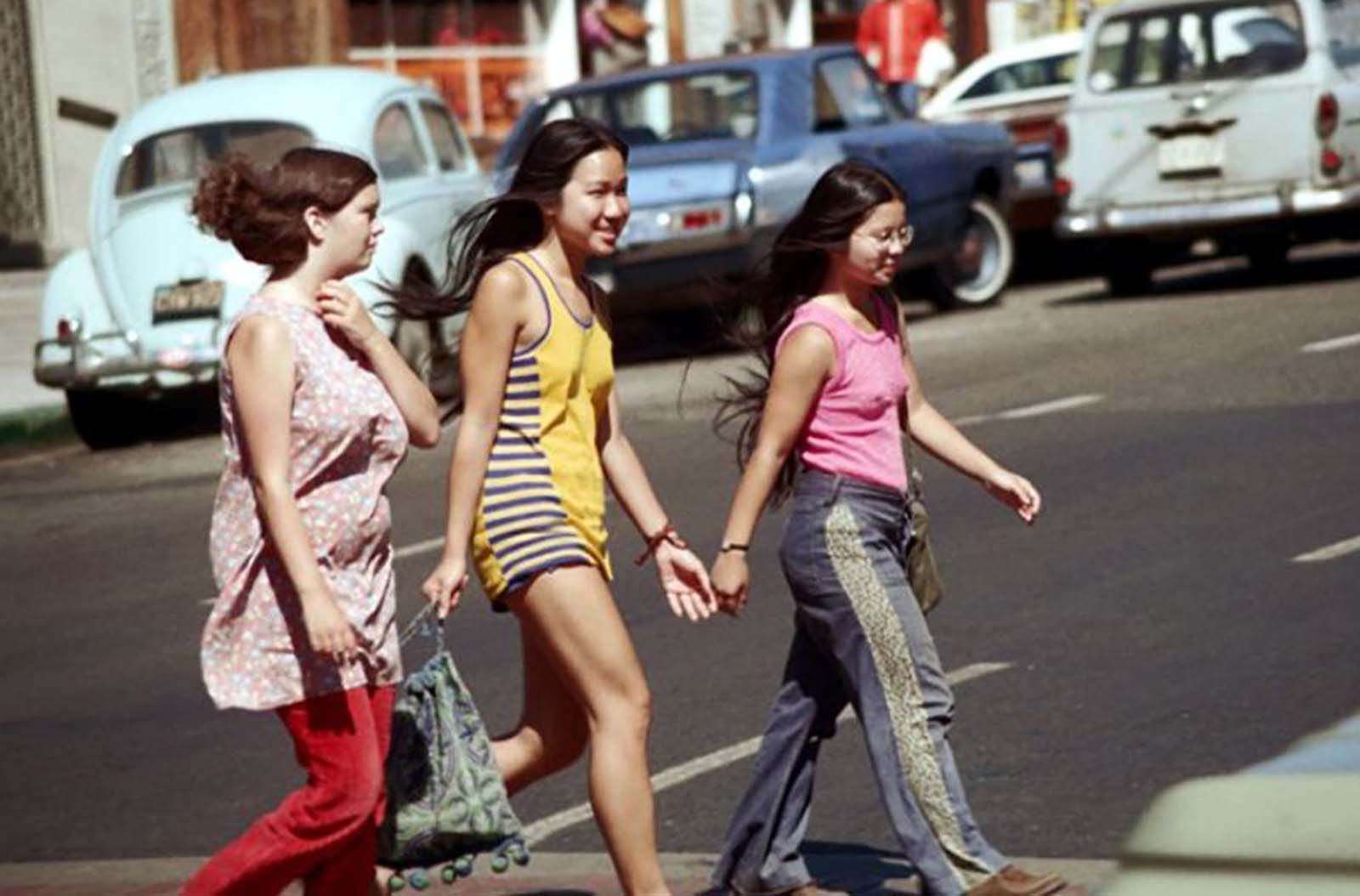
Fashion in early 1970s San Francisco reflected a city in the middle of cultural change.
The streets became a stage for personal expression, where young women mixed vintage pieces, handmade garments, and bold new trends into looks that felt effortless and individual.
Away from the polished pages of fashion magazines, candid street photography captured a more authentic side of the era, revealing how everyday people interpreted one of the most creative decades in modern style history.
 The decade arrived as a direct extension of the hippie movement that had swept through the 1960s, and nowhere was that more visible than on the West Coast.
Tie-dye shirts, Mexican peasant blouses, folk-embroidered tops, ponchos, and military surplus pieces were staples of the early ’70s wardrobe.
Below the waist, women gravitated toward bell-bottoms, frayed denim, midi skirts, gauchos, and flowing ankle-length maxi dresses.
 Bold colors ruled the look, with Indian-inspired prints, Native American patterns, and vivid florals appearing on nearly every street corner.
Accessories carried just as much visual weight as the clothing itself. Conventional jewelry was largely set aside in favor of chokers, handcrafted neck pieces, and ornaments made from natural materials such as wood, shells, stones, feathers, leather, and Indian beads.
Headbands, floppy hats, flowing scarves, Birkenstocks, and earth shoes completed the picture, frequently worn by men and women alike as part of the era’s broader embrace of unisex dressing.
 Not every woman followed the bohemian path, however.
Many dressed with a polished glamour that drew inspiration from 1940s Hollywood, favoring structured silhouettes and refined details that stood in deliberate contrast to the looseness of hippie style. Others kept their wardrobes simple and unpretentious.
A particularly common approach was mixing new pieces with carefully chosen vintage finds from the 1930s, 1950s, and 1960s, assembling looks that felt personal, layered, and entirely their own.
 Running parallel to the free-spirited aesthetic was a cleaner, more tailored sensibility that was quietly gaining ground.
Fitted blazers, mini skirts, hot pants worn with skin-tight tops, wide-leg trousers, and floor-length evening gowns all had their moment in the early ’70s wardrobe.
The color palette for this more structured look leaned heavily on soft pastels, with mauve, peach, apple green, baby blue, wheat, camel, and pale yellow appearing frequently across the era.
 From around 1973 onward, the mood shifted toward warmer, earthier tones, and shades like rust, tangerine, copper, forest green, and pistachio moved to the center of the conversation.
Knitwear became one of the most defining elements of the period. Sweaters were so central to the early 1970s look that an entire outfit could be assessed by the quality and character of just one.
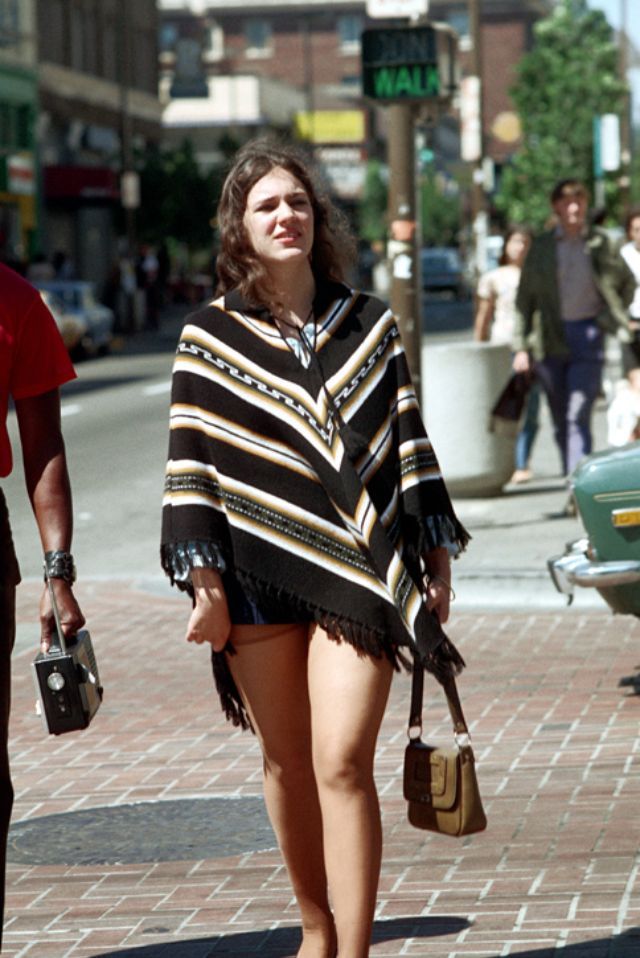
The category expanded rapidly into sweater coats, sweater dresses, floor-length knits, and full sweater suits, many of them trimmed with faux fur and finished with chunky shawl collars, wide belts, or deep ribbing.
Browns, creams, and warm neutrals were the dominant shades, giving the overall silhouette a grounded, organic quality that perfectly matched the era’s sensibility.
 Boots, meanwhile, had reached the height of their cultural moment.
Building on the momentum that began in the mid-1960s, footwear in the early 1970s was remarkably varied and widely affordable, with go-go boots, crinkle boots, stretch boots, and granny boots among the most popular styles.
 They were worn with nearly everything, from micro minis to wide-leg denim, and represented one of the few fashion items that crossed every style divide of the decade.
The candid street photographs from San Francisco during this period capture all of it, not the polished version, but the real one. Scroll through to see how the women of San Francisco actually dressed in the early 1970s.


(Photo credit:The Nick DeWolf Foundation via flickr.com/photos/dboo).