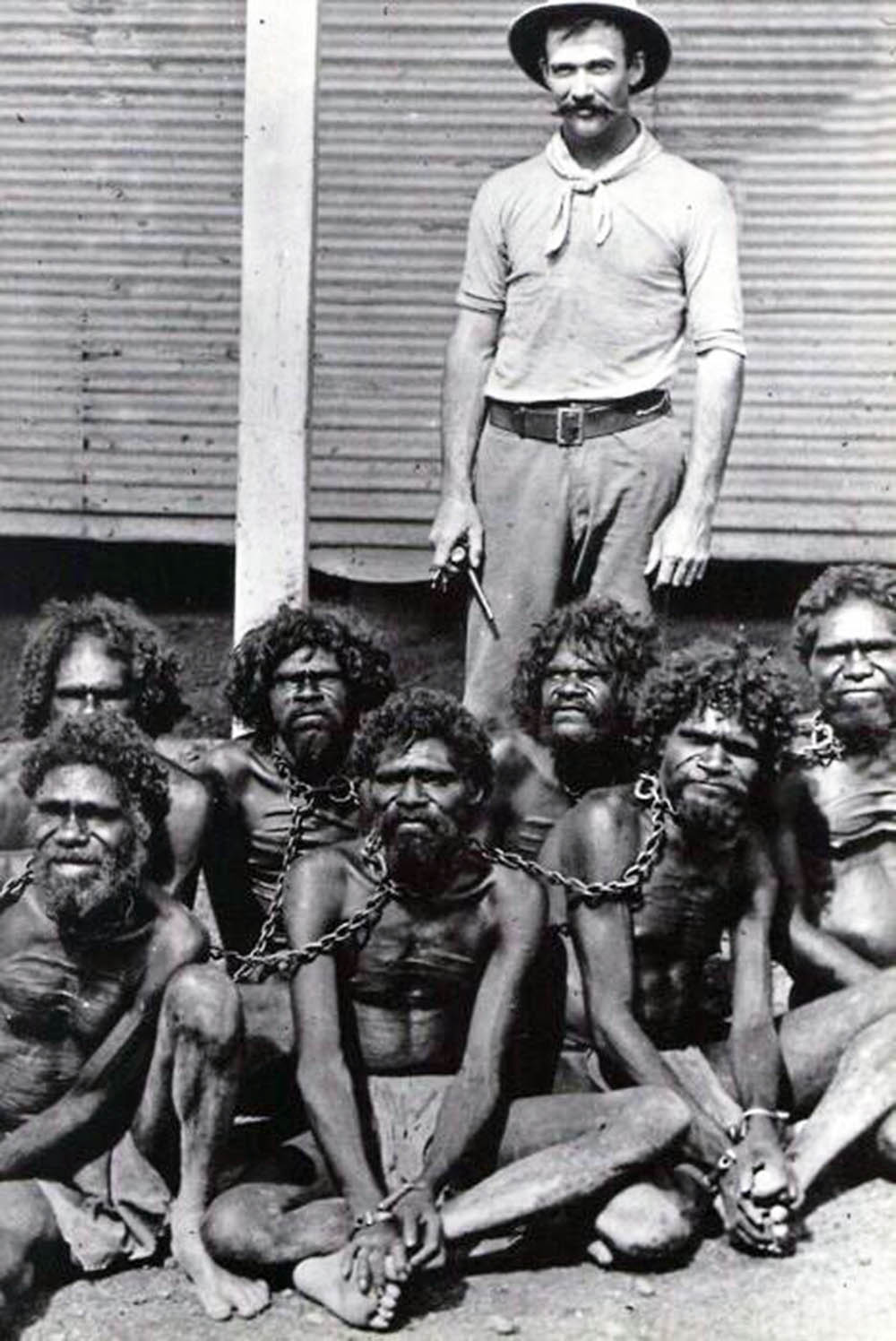
This picture is taken in the early 1900s at the Wyndham prison. Wyndham is the oldest and northernmost town in the Kimberley region of Western Australia.
It was established in 1886 as a result of a gold rush at Halls Creek. However, the circumstances and the story behind this picture remain unknown.
The Aboriginals could have been arrested under the various local laws passed that forbid them from entering or being within a certain distance of named towns.
They could also have been arrested for drinking or owning firearms which were illegal for them at various times.
It’s also possible that they have been rounded up to be moved to reserve areas which were being created at the time and that these individuals did not want to move. It could even be a staged picture for tourists/publicity reasons.

Long after such practices were assumed to belong to a distant colonial past, Aboriginal people in Western Australia were still being restrained with neck chains.
As late as 1958, witnesses in Halls Creek, in the Kimberley region, reported seeing Aboriginal prisoners chained for weeks at a time to a veranda post outside the local police station.
These scenes were not isolated incidents but part of a broader system of control that operated with little scrutiny for decades.

From the late nineteenth century through the mid-twentieth century, horse-mounted police routinely detained Aboriginal men, women, and children from pastoral stations across the north of Western Australia.
Their removal was often justified by allegations of cattle theft, though their presence itself was seen as an obstacle to the rapid expansion of the cattle industry.
At its height, between the 1880s and the 1940s, hundreds of Aboriginal people were bound with heavy iron neck chains, each weighing about 2.4 kilograms, and forced to march vast distances from their country, sometimes as far as 400 kilometers.
In some cases, prisoners were further restrained by being fastened to iron rings set into the floor.

Indigenous men linked together by chains around their necks. Taken sometime between 1898-1906.
The chains themselves were secured using Yale or Hiatt padlocks, but earlier methods were even more brutal.
Before 1905, prisoners transported from Wyndham were restrained with iron split links purchased privately from a Perth ironmonger rather than issued by police.
According to official records, these links could only be removed with a hammer and chisel, with the prisoner’s head placed on a blacksmith’s anvil, a process that could take up to ten minutes. Despite the obvious danger, this method remained in use for years.

‘The pastoralists might’ve had their euphemisms – such as “dispersal”, when what they really meant was killing.’
Authorities justified neck chaining largely on grounds of cost and practicality. Western Australia covered an immense territory, the largest police jurisdiction in the world, yet was staffed by very few officers, and many early lockups were poorly built and insecure.
Prisoners frequently escaped, and chaining was promoted as an efficient solution. Local officials argued that critics in Perth, more than 3,500 kilometers away, did not understand the realities of policing such remote regions.
Neck chains were even described by some as the most “effective and humane” restraint because they left the hands free, a claim supported by police leadership and influential pastoralists who wanted Aboriginal people removed from their stations.

Northern Territory Aboriginal prisoners, 1800s.
This rationale came under intense scrutiny in 1905, when Dr. Walter Roth’s royal commission into the condition of Aboriginal people exposed Western Australia to international condemnation.
While regulations permitted the use of ankle chains in prisons, there was no legal authority for neck chains, which were nevertheless applied for the full duration of a sentence.
A senior government witness admitted to Roth that the practice had been informally accepted for at least 30 years.

Aboriginal men in chains. Frontier conflict and disputes over territory saw thousands of Indigenous Australians apprehended by colonial authorities.
Although neck chains were officially banned following the commission, the decision was short-lived. Once public outrage subsided, the practice was quietly reinstated in 1906.
The use of neck chains extended beyond alleged criminal punishment. In the 1880s, Aboriginal men and women around Broome who were kidnapped or coerced into pearl diving were restrained in this way.
During the 1930s, people near Wyndham suspected of having Hansen’s disease were chained and forced to walk approximately 500 kilometers to the Derby Leprosarium at Bungarun.

Prisoners in chains with a white man holding the end of the chain, probably in Wyndham, ca.1930.
Official records also reveal how this culture of punishment persisted well into the 1950s.
In 1953 at Moola Bulla, a government-run pastoral station with a school for Aboriginal children, an 11-year-old boy reported that the schoolmaster, Robert Johnson, placed several children in neck chains for hours as punishment for misbehavior.
Other witnesses later confirmed that children as young as six had been subjected to the same treatment. Johnson was eventually dismissed, but the episode illustrated how normalized such practices had become.
 Neck chains were finally abolished in late 1958 following sustained national and international criticism, particularly from church groups and trade unions, alongside the introduction of police vehicles equipped with secure lockups.
For many Aboriginal people, including the children at Moola Bulla, this reform came only after generations had already endured the weight of a system designed to control, intimidate, and remove them from their land.


Chained men, again in the Kimberley. Date unknown.


(Photo credit: Australian Archives).