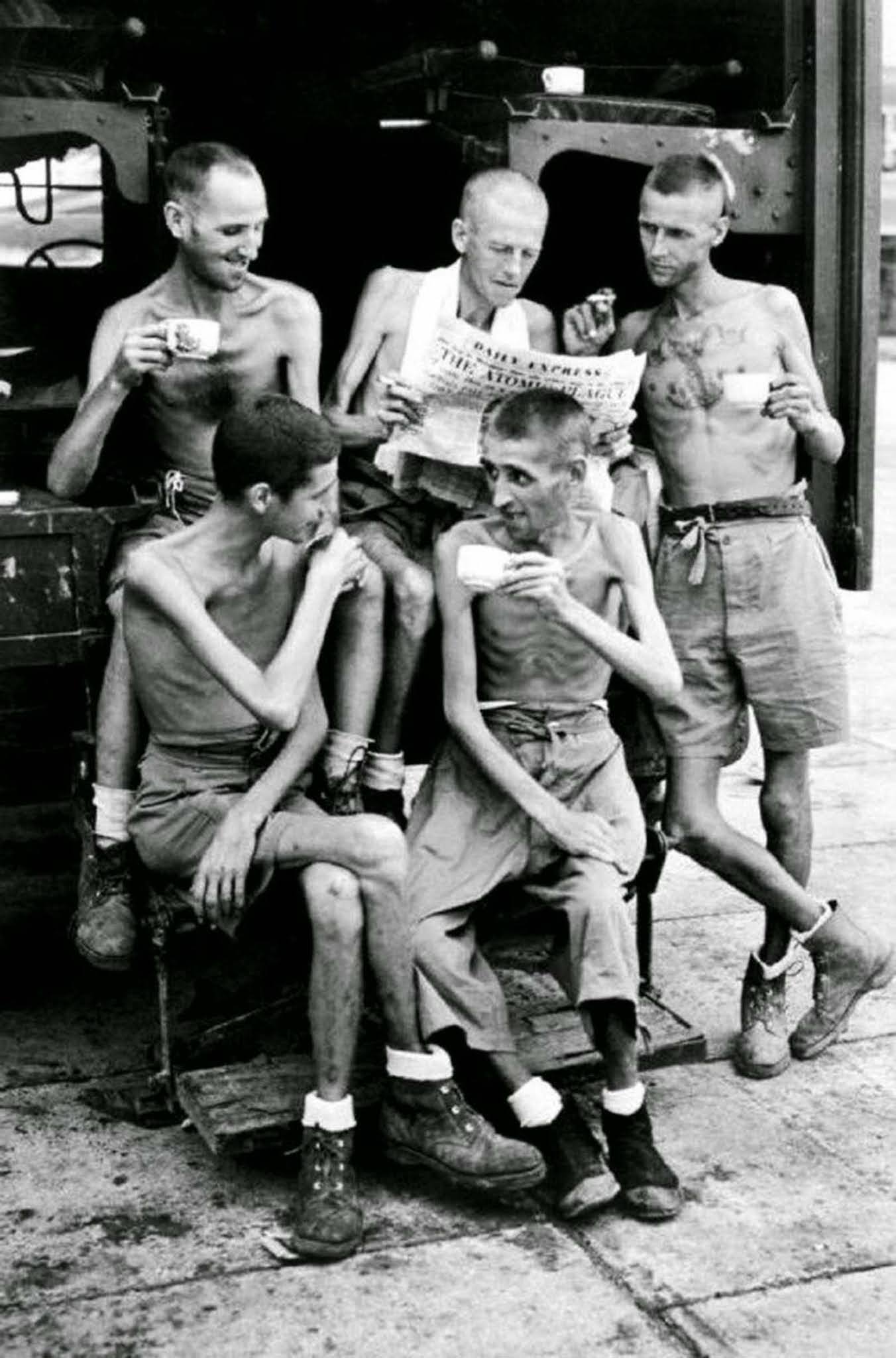
Liberated British prisoners of war in the Far East, 1945.
Five emaciated former prisoners of war sitting on the steps of an ambulance in Singapore following their release from captivity in Sumatra.
Holding the newspaper is Sergeant Jack King RM, formerly of HMS Prince of Wales, while standing next to him, with the distinctive chest tattoo, is Private Tom Wardrope of 2nd Battalion, Argyll and Sutherland Highlanders.
The brutal treatment inflicted upon these men by their Japanese captors is clearly illustrated by their poor physical condition.
The newspaper the soldier was reading is “Daily Express”, dated September 5th, 1945. The headline: “30th Day in Hiroshima: Those who escaped begin to die, victims of – The Atomic Plague”.
These British prisoners were held on the Changi POW camp. Often thought to be synonymous with horror it was in fact a relatively comfortable camp, at least compared to those on Borneo, Ambon, Hainan, Japan, and the Thai–Burma railway.
The Japanese used the POWs at Changi for forced labor. Men were made to work in the docks where they loaded munitions onto ships.
They were also used to clear sewers damaged in the attack on Singapore. As the end of the Pacific War approached, rations to the prisoners of war were reduced drastically.
To be more precise ration scales were reduced even for the Japanese as resupply from outside Malaya/Singapore became more difficult as the war progressed.
It must be noted that at the same time Japanese front-line troops were dying of starvation in New Guinea (and turning cannibal if eye-witness accounts are to be believed).

Colorized version by Hristos Kaplanis.
Individuals experiencing starvation lose substantial fat and muscle mass as the body breaks down these tissues for energy.
Depending on the level of starvation the full recovery might take as long as one year. There have been cases when prisoners have died from eating too much afterward.
This is called Refeeding Syndrome which is a syndrome consisting of metabolic disturbances that occur as a result of reinstitution of nutrition to patients who are starved or severely malnourished. That’s why recovering patients are only to be given water, milk, and juices for the first 3-5 days of recovery.
When individuals who are starving suddenly get given a bunch of food, their body switches quickly from eating itself to rebuilding.
This causes big shifts of minerals out of the blood and into the cells, and blood levels plummet, where previously they were being artificially maintained.
It’s actually got a mortality rate of about 20%. Most of the research on it was done after all these individuals getting out of POW camps were stuffed with food and died instead of recovering.
They need to slowly bring starving people back to normal calorie diets, and watch their blood chemistry closely.
(Photo credit: Imperial War Museums / Part of Oliver Zina Collection).